


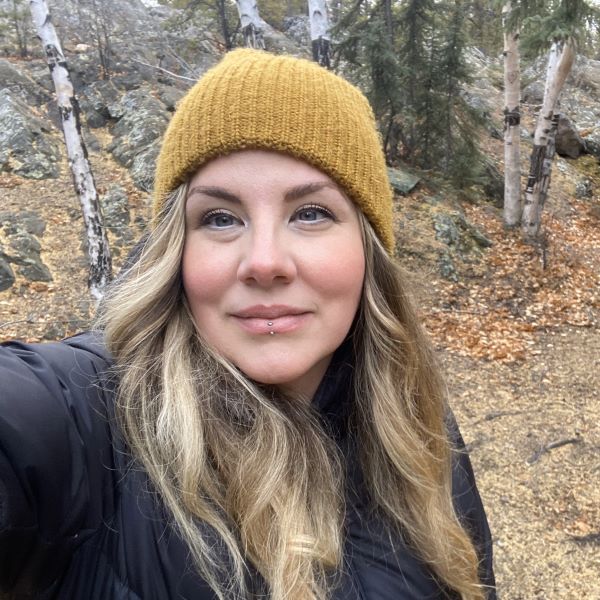
Dr. Courtney Chetwynd is an interdisciplinary artist–researcher and community organizer, rooted from childhood in communities of the Eastern and Western Arctic, where she continues to make her home. She approaches art, research, and community care as interconnected practices shaped by place, reciprocity, and relational knowing. She holds a Ph.D. in practice-led research and interdisciplinary studies from the University of Dundee’s Duncan of Jordanstone College of Art and Design, along with an MFA from the University of Calgary and a BFA from Mount Allison University. Her artistic and academic work explores embodied and place-based knowledge through land-based methods, sensory inquiry, and collaborative processes with human and more-than-human relations.
Courtney’s community work spans health and well-being, climate resilience, food security, and culturally grounded mental-health responses. She brings a trauma-informed, relational approach to organizing—building programs that support collective resilience, centre local leadership, and honour the emotional and cultural realities of Northern communities. A bridge-builder across sectors, she translates between artistic, academic, bureaucratic, and community worlds to make systems more navigable and supportive.
Her academic and artwork have been exhibited nationally and internationally. She has been recognized through grants and awards from the Canada Council for the Arts, Alberta Foundation for the Arts, Banff Centre for Arts and Creativity, the University of Calgary, the Centre for Research in the Fine Arts, the Government of the Northwest Territories, and the Northwest Territories Arts Council.
At the heart of her practice is the understanding that place is an active collaborator—shaping story, memory, and meaning. Through interdisciplinary inquiry and thoughtful material engagement, she creates work that is resonant, poetic, and grounded in the relational ecologies of the North. Her practice functions as an ecosystem, weaving together art-making, community stewardship, and land-based learning into forms of cultural, emotional, and collective care.
Events with Courtney Chetwynd
 The Art of Entanglement: Fish, Flow, and Knowing
October 2 - 7, 2026
Dive into a creative world where fish, water, and story are teachers. Building on the energy and excitement of last year’s “Fish as Storytellers”, this year’s program moves more deeply into themes of entanglement, reciprocity, and relational ways of knowing. Through art-making, storytelling, and land-based reflection, we’ll explore how knowledge…